Friday, April 12, 2013

Take Note: Memories Set to Music


     Although not blessed with musical talent myself, I've had a lifelong appreciation for song.  There are some vivid memories I associate with music, which probably contributed to this enjoyment.
     My grandmother certainly made an impression, by regularly singing snatches from a couple of pieces from the early part of the 20th century.  The first was K-K-K-Katy, a WWI favorite written in 1917, and published in 1918.  It made a real impression on her at the time:  not only did it make use of her first name, but she was a young teenager, and full of romantic dreams.  I have the original sheet music from that time.  Someone has posted a recorded portion to Youtube at http://www.youtube.com/watch?v=8_J9kPQ8hwA , set to a an appropriate slide show, including a picture of the sheet music.
     Another gem from her childhood, and passed on to me, was the 1906 tune about Arrah Wanna, the Indian maiden who married Irishman Barney Carney.  Nothing about this song is historically authentic or politically correct, which didn't register on my little kid mind.


   The chorus, which is the only part I knew, went like this:

                                                    Arrah Wanna, on my honor,
                                                    I'll take care of you,
                                                    I'll be kind and true
                                                    We can love and bill and coo,
                                                    In a wig-wam built of sham-rocks green
                                                    We'll make those red men smile,
                                                    When you're Misses Barney,
                                                    heap much Carney,
                                                    from Killarney's Isle.

The online National Jukebox section of the Library of Congress has an original recording at http://www.loc.gov/jukebox/recordings/detail/id/6130/ .
     My mother updated the musical tradition, by singing snatches of her own favorites.  One sounded to me like, "I don't want a rickshay romance," but turns out to be a song titled Ricochet Romance, released in 1953.  I think Mom never got beyond the first line of the chorus:  "I don't want a ricochet romance, I don't want a ricochet love." Another random lyric of hers was, "Bongo, bongo, bongo, I don't want to leave the Congo." I was shocked when I heard this ditty sung on a recording by Danny Kaye and the Andrews Sisters, from 1947. The song is actually titled "Civilization," and is quite long and complicated. Another short sample of hers was "Let's take a boat to Bermuda." She got a little bit farther in this one, which was titled "Let's Get Away From it All," originated by Tommy Dorsey. I remember this bit:
Let's take a boat to Bermuda
Let's take a plane to Saint Paul
Let's take a kayak, to Quincy or Nyack,
Let's get away from it all.

     And, finally, her classic take on the 1949 show tune from South Pacific, "Bali Hai."  Instead of Bali Hai, she'd bellow, to the same tune:  "BELLY ACHE!"  We'd all guffaw at that one, without a clue of the song's origins.
     You can bet that hearing any of these instantly transports me back to a very different time and place.


Wednesday, March 20, 2013

Fun With DNA, or, Will Oprah Boost Me Over the Brick Wall?

      Last year, I listened to a Genealogy Gems podcast, where host Lisa Louise Cooke (http://lisalouisecooke.com/) interviewed Bennett Greenspan, President & CEO of Family Tree DNA.  I'd also heard a talk earlier in the year by Dr. Bryan Sykes, Professor of Human Genetics at the University of Oxford.  In the years since DNA testing has become widely available to the public, I had remained uninterested in the subject.  Whenever a genealogy magazine published an article on the topic, I would skip to the end to see how it turned out.  I also had concerns about privacy, and which company had an established history.
     Once I learned about autosomal testing, however, I became intrigued.  This is how the Family Tree DNA website (FamilytreeDNA.com) describes their "Family Finder" test:  "Family Finder uses autosomal DNA (inherited from both the mother and father, four grandparents, eight great-grandparents, etc.) to provide you a breakdown of your ethnic percentages and connect you with relatives descended from any of your ancestral lines within approximately the last 5 generations."
     It dawned on me that the window for collecting a DNA sample from my 88-year-old mother is rapidly closing.  And so began the great DNA collection project.  How would I approach the subject from two states away, where my mother lives in nursing home care?  Luckily, my sister lives near her, and was on board.  Now, mom is the feisty type, who doesn't necessarily agree with a first request.  She also spends a lot of time having various medical tests and procedures.  We were afraid that asking for a DNA sample would be one of the few things she could control, and she'd say no.  My sister opened the topic by explaining that our mother would be contributing to science, and that we might eventually know more about the connections and origins of her beloved "daddy."
     We also had a secret weapon.  My mother is a huge admirer of Oprah Winfrey, who'd had her DNA tested.  I'm not familiar with the details, but apparently my mother knew all about it.  My sister brilliantly reminded her of Oprah's story when she asked mom about getting a sample.  Apparently, what's good enough for Oprah is good enough for my mom, who agreed with enthusiasm.
     A little ruse we employed, was to have my sister rub a plain old swab inside her own cheek, to show how painless it was.  Then she said, "Okay, your turn!," and produced the actual test kit for my mother.  Off it went in the mail to Texas.
     Fast forward almost three months.  We were stunned at how eagerly my mother anticipated the results.  When I was notified that they were ready, I took a quick look.  My mother is described as Western European, comprised of 89.78% Orcadian, and 10.22% "Palestinian, Adygei, Bedouin, Bedouin South, Druze, Iranian, Jewish."  Hmm.  They lost me after Western European.  I also checked out some of the people described as having matches to my mother, and will study that topic further at a later date.
     My sister, after hearing all of this, got to work on the internet to turn this into an entertainment opportunity for mom.  Turns out Orcadian refers to the Orkney Islands near Scotland, and serves as sort of a genetic crossroads.  Orcadians are the descendants of Iron Age Picts, Vikings, and Scots (sounds pretty British, which wasn't much of a surprise).  There are a number of fun websites online devoted to things like local Orkney festivals.  One of these is the annual celebration of the horse.  Since our mom owned and was passionate about horses her entire life, she was thrilled about that connection, yelling, "See?  I was born to ride!"  And, she gave a belly laugh about her 10% desert heritage.  She hasn't stopped talking to everyone about "her" results.  My sister says it's as though she dreamed up her own perfect genetic cocktail.
     Remember me saying I wasn't much of a scientist?  That hasn't changed.  I still have way more questions about what all of this means.  And, I have come to learn that this test isn't going to provide many firm answers.  For one thing, nobody's vetting the research on the paper genealogies provided by the test subjects.  We only know we are related, but not necessarily how, not even whether it's on the maternal or paternal lines. And, in some cases, we might only be genetically related in the sense that we're white Europeans who spent time in Ohio, for example, which isn't the same as being "related."
     But, does this matter to my mother?  No!  In fact, we all had so much fun with this, I ordered another test to be done on my mom.  This one is for the full sequence mitochondrial DNA, which studies the mother's mother's mother's line deep into history.   We'll now be able to tell her more about her oldest female ancestor.  No doubt she'll be thrilled about this, too.  I'm having an extra sample kit stored for the future, when newer tests might unlock more about our ancestors.
    It's been quite an undertaking, making a rainy winter in rural Washington very exciting for a fragile senior citizen.  Thanks Oprah!  

Tuesday, March 5, 2013

Love Over Coffee: Isaac L. Myers & Hester Burgard


     Among the more unusual items that have passed through the generations of my family is this 19th-century coffee grinder.  It's known to have belonged to my 2nd great-parents, Isaac L. Myers and his wife, Hester Burgard, who was called Hetty.  One theory is that he constructed it as a gift for her at the time of their Civil War-era wedding.  I'm not sure whether this part is true.  While there are certainly some elements of the piece which could have been built by hand, the mechanism probably wasn't.  There are some patches of glue on the back side of the drawer, perhaps it was repaired along the way.  I've seen similar items on eBay, so a coffee grinder from this period isn't especially rare.  
     Isaac L. Myers was born 4 April, 1841, in York County, Pennsylvania.  He served just over three months in Company B of the 1st Battalion, PA Volunteer Infantry during the Civil War.  The timing of his enlistment, in June of 1863, suggests that fears of the Confederate advance toward nearby Gettysburg must have prevailed over the pacifist teachings of the Church of the Brethren, of which he was a member.  Or, perhaps he was restless for "adventure."  Whatever the circumstances, soon after he moved to Astoria, Fulton County, Illinois.  Hester Burgard, born 31 March 1844 in Cumberland Co, PA, was a member of the Brethren Church there.  Isaac had become the singing master of the church, and Hetty "set her cap" for him.  He never stood a chance:  they were married March 5, 1865. 
     The couple lived at various times in Illinois, Kansas, and finally in Washington state, farming and serving the Brethren community.   They became parents to two sons and two daughters, all of whom left descendants.  Isaac died in 1912, Hetty lived on until 1932.  I was able to visit their last home together shortly before it was torn down.  Today the site, on the corner of Gold & Locust Streets in Centralia, Lewis County, Washington, stands vacant.
     Whatever the origins or value of this old, beat-up coffee grinder are, the link to this hard-working, kind, and loving couple is priceless. 
     

Tuesday, January 29, 2013

Art From the Heart: Saluting French Roots


     For several years I took a watercolor painting class at the local community college, and there was no doubt that I languished near the bottom of the talent pool.  I did, however, meet a lot of nice people, and had a good time.  One of the other students was a cheerful, kind, older lady, who was born in Épernay, the heart of the Champagne region of France.
     Eventually, time and health issues caught up with her.  She moved across the country to be closer to her family, and took an apartment in an assisted-living facility.  We all missed her sweet presence.
     Recently, I had an idea to let her know we were all thinking about her.  I enlisted the help of one of the best students in the class, to create a watercolor depicting a "house" of some sort.  While I was expecting her to spend a short time on a ten-minute sketch of a cottage, and accent it with a few washes of color, she went a different route.  She made this lovely painting of Chateau de Chenonceau, one of the more popular historic sites in the Loire Valley of France, then matted it and placed it into a blue frame.  I then scanned the piece, and added the phrase "Chez Claudine" in a complimentary color, using a font called "French Script."  Next, I reproduced the painting on cardstock, and put it in a cheap white frame with a hanger made from lavender bias fold tape from my sewing supplies.
     Now, Claudine can enjoy the original painting in her apartment, and hang the copy outside the front door as a sign of welcome.
     Art from the heart:  the best product of my less-than-stellar painting career.

Sunday, January 27, 2013

Frontier Indiana: hotbed of sin?

     Loosening the brick wall surrounding an ancestor can involve drilling pretty deeply.  A case in point is the study I've made of some records in Lafayette, Tippecanoe County, Indiana, for more clues on my ancestor Allen Ives.
     The Records of the First Presbyterian Church of Lafayette, IN, 1828-1914 are available on FHC film #877704. The only reason I viewed this film, is that it covered the early period of time I was interested in, and I wanted to see what might turn up with careful study.  This is often the case with any library materials, you generally have no idea exactly what to find within a book or microfilm until you devote some time to it.  And by that, I mean more than just flipping through the index at the back for ancestral surnames!
     In this instance, I found images of the original, handwritten records on the film.  While not indexed or easy to read, the source gave a wealth of information including names, locations, and what topics were important.  Here are some notes I made while reading:

First members, August, 1828:
James Cochran & wife Rachel, John McCormick & wife Elizabeth, Elizabeth Trimble, Elizabeth Miller, Margaret Carson (certificate from New Brunswick, NJ).  Minister:  James Crawford.  Names mentioned:  Mary Slone returned to Dayton, Hugh Cochran & wife Maria, Mrs. Hannah McGuire, Henry Miller (Senior), of Benson, KY, and James Cochran elected elders. 


Lengthy action taken against Hugh M. King, guilty of un-Christian conduct:  "irreverent and foul language, visiting the groceries and of using ardent spirits to excess, guilty of breach of the Sabbath by visiting the groceries and associating with loose company on this holy day, speaking disrespectfully of the church of which he is a member and of some of its members." 1831

1834  The case of Martha Cochran was taken up, being charged with fornication, and having herself confessed it and its becoming clearly evident by the birth of a child.
"...to be suspended from the privileges of the church...and she is hereby suspended.  But while she is thus suspended she is not to be regarded as cut off, but is to be watched over and admonished and prayed for that she may be led to true repentance and to the enjoyment of the favour of God."  (Reinstated in 1835.)


1835:  New members Asa Allen & Mary Ann Allen his wife, new members from Hampshire Co, VA.  Left shortly after to join church in Monticello.

I stopped studying the film after I knew my ancestors had left the community.  Did I ever find mention of the name Ives?  No.  However, I thoroughly enjoyed gaining a rich insight into how the people of the community felt about certain issues during that early period, who might have been related to whom, and where some of the residents had come from.   Perhaps these will be useful clues for further study down the road.


Saturday, January 12, 2013

Ask a Librarian: Francis Marion Singer


     Back in the stone age of my ancestral search in 1980, using the resources of a library was a common thing.  I had yet to get a home computer, and digitized genealogical materials were a long way off.  Fast forward to the present, and the belief, by some, that "it's all online now."  (Hearing this makes me cringe, but that's a whole other subject.)  While new resources are frequently being made available via the Internet, the library still plays an important role in making information available to us.
     The past couple of years have been about reassessing the data I already have, and seeing where I could have done a better job.  During this process, I realized that I didn't have an obituary for Francis Marion Singer, half-sibling to my ancestor, Allen Ives.  From the records posted on Findagrave.com, I knew that "Frank M. Singer" was buried in Fountain Park Cemetery, Winchester, Randolph Co.,IN.  The photograph of his headstone shows a death date of December 13, 1903.
     Armed with a likely date and place, I located a website online for the nearest public library.  Following the procedures outlined on the site, I directed an e-mail to the appropriate party, asking whether someone might check the microfilmed copies of the local newspaper around that date.  I also asked whether they wanted a fee in advance, and whether I could pay extra to have them check for any other articles such as funeral notices, thank yous from the family, and the like.  The fee settled on was $10.  I received a packet before they could have received my check, which included not only the F. M. Singer obituary, but an account of the accident that caused the amputation of his leg (with four doctors in attendance), an update on his condition (he could "set" up), a biography from a county history, and, for good measure, some other obituaries for individuals named Singer, including a very detailed one for his second wife.  Among the information new to me was the description of where his property was located, a pastor's name, and the fact that F.M. Singer was a Mason.
     In this example, I use techniques I would have used in 1980, updated to make use of the internet as an additional tool.  In the end, however, it was the extra effort of a dedicated librarian, which provided me with these great, time-saving results.

Friday, January 4, 2013

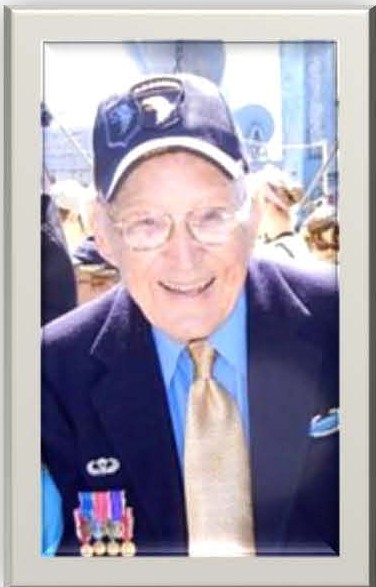
W.C. "Andy" Anderson: Gentleman War Hero


     In June of 2012, my uncle by marriage, Wilford C. "Andy" Anderson, received France's highest-ranking medal of valor, the Chevalier de la Legion d'honneur, for his WWII service.  An article about the events marking the occasion can be found here:  http://www.sfgate.com/living/article/S-F-vet-to-get-France-s-medal-of-valor-3646100.php .  He was part of Company C, 517th Parachute Infantry Regiment, 13th Airborne Division.  A unit history can be found here:  http://www.ww2-airborne.us/units/517/517.html .  His name is on a short list which shows the unit's recipients of the Distinguished Service Cross.
     Long before I knew of "Wif's" (as I called him) military service, I knew him as a gracious, welcoming, and kind individual, with a wry sense of humor.  We have enjoyed many pleasant and interesting conversations throughout the forty-five years or so that I've known him.   
     On two recent visits, he greeted me warmly, and the time flew by as we reminisced.  At one point, I examined some photos and medals displayed on the wall, and we talked about his time in the military.  As platoon sergeant, he bore heavy burdens, and has some dark memories of that time.  But,  in his typical fashion, he also took the opportunity to poke gentle fun at the idea of himself as a "war hero."  "Oh, no," he said.  "it was all because I remembered my high-school German! I just told them, "Raise your arms, and you will live.  I have cigarettes, food, and drink.  Or, keep your guns, and you will be dead.""  He said that they came to him very willingly at that point, many of them being "just kids of sixteen or so."  The certificate on the wall, accompanying the Distinguished Service Cross, paints a much more frightening picture.
     On another occasion, he was on a night parachute jump.  The plane left Italy and headed into France, the site of the jump.   He landed upside-down in a tree.  Thinking he was about 30 feet up, he decided to open the auxiliary chute and climb down.  At that point, he heard a private at eye level say, "Whattya doin,' Sarge?"  He had come to rest in an apple tree, and only had to turn over, to be on the ground.  When I mentioned that I couldn't imagine jumping out of a plane at night, with no idea what faced me at the other end, he replied modestly, "Oh, well, that was combat."
     Wif's training took place in Toccoa, Georgia, with the 506th, the outfit which would come to be known in the book and film as the Band of Brothers.  He freely admits that he probably would not have survived, had he continued with that unit.  An officer asked him to remain behind, and continue as platoon sergeant with a new outfit, which became the 517th.
     Luckily, Wif returned home, and became a devoted husband to his sweetheart, the former Phyllis Foulkes.  The tender care he took of her as she became ill late in life, was another act of heroic bravery.
     The greatest generation, indeed.

Addenda:  W.C. "Andy" Anderson passed away peacefully on April 1, 2013