Friday, July 14, 2017

The Quiet Heros - Remembering Wartime France


Today is July 14, Bastille Day, an important date on the French calendar. It reminded me of this video I made a couple of years ago, honoring the World War II service and sacrifice of family members.

The Quiet Heroes - Remembering Wartime France


Left, Bobby Glos, 1923 - 1944, killed in action
Eltie Glos, 1912 - 2007
John Pina, Jr. 1922 - 1983

Jack C. Francis, left, 1920 - 1989


Friday, June 2, 2017

Grateful for the Kindness of Strangers


     Over the years, it’s been a pleasure to the witness many instances of genealogists and historians taking time to assist other researchers. I well remember my early, stumbling steps studying my own family history, where I was often pointed in the right direction by others. This was in the days when letter-writing was a big part of the process. I lived for the days when I’d receive an envelope with hand- or type-written family group sheets, part of a family tree, or copies of photos and documents. This blog is in part a salute to their efforts, where I share some of my own discoveries, and give my ancestors some context. 
     Recently, I ran across another example of someone making the extra effort to ensure his ancestor wasn’t forgotten, by pointing future generations to her final resting place. (I have no relationship with this family.) Long before the advent of FindaGrave.com, or the wide sharing of information that’s possible via the internet, he inserted a piece of graph paper into a local book of typed cemetery inscriptions, on which he’d carefully drawn a map, shown here.
Insert showing details of the grave of Emily Osburn Durant, as of 1981, by Gary Moore

     Writing in 1981, the author, Gary Moore, knew that Emily Osburn Durant’s parents were David J. and Sylvia Osburn, and he helpfully directed the viewer to lot 195 of Buckeye Cemetery. Comparing this data to the present-day listing for Emily Durant on FindaGrave shows a less intuitive result, because a clickable link to her parents isn’t available. One would have to do a broader search for the Osburn surname within the area. The listing shows the headstone now to be in the Old Van Buren Cemetery, Van Buren Twp., Jackson Co., Iowa. The current photo of the headstone shows that it has been reset at some point. Perhaps it’s been moved from its original location on the map. 
     It is lovely to think, that in her short eighteen years of life, Emily inspired a legacy of kindness.
Emily Osburn Durant, courtesy FindaGrave.com

Wednesday, March 29, 2017

He Spoke to Me Across Centuries: Asahel Roundy


     Sometimes, the reward of a journey can't be measured by how much it advances my original goal.  This piece is among the most striking, of the many I handled on my September 2016 trip to New England, even though it doesn't concern my "direct line."
     The branch of the Roundy family I’m interested in lived in Rockingham, Windham Co., Vermont.  Some of the family lived across the Connecticut River, in Lempster, then Cheshire Co., now Sullivan Co., New Hampshire.  When I visited the New Hampshire Historical Society in Concord, the welcoming staff was eager to help me connect with the history of my family.  They produced a remarkable document.
Asahel Roundy letter, 1777,
from the collection at the New Hampshire Historical Society
     This letter was written by a young man during the Revolutionary War, Asahel Roundy.  As a son of Samuel Roundy, he was nephew and cousin to my ancestors, the John Roundys, Sr. and Jr.  I could lift and smooth my hand over the actual paper he used out in a camp somewhere (after the battle of Stillwater, NY).  I wish now I'd taken more time getting the perfect image with a different device.  But as so often happens, I was rushing to find one more source, in one more repository, before day’s end.
     The two inserts below show my attempt at a transcription, and the typed explanation sent, when the letter was donated to the New Hampshire Historical Society.  It broke my heart, knowing that this young soldier would die four short months later, after “a littel butter and a littel shugar” had made him so happy.
     I will always remember his story.


Note:  Evidence of Asahel’s service and death can be found in the roll of Col. Benjamin Bellow’s New Hampshire regiment, the bounty paid for his enlistment, and notation of his death in January, 1778 in the original, handwritten battalion roll.  More about the circumstances faced by his unit is found in the book, "Death Seem'd to Stare": The New Hampshire and Rhode Island Regiments at Valley Forge,” by Joseph Lee Boyle.

Sunday, January 8, 2017

David Ives - Allen Ives: Further evidence

Having just spent considerable time composing the previous message, I couldn't get the story and its tragic circumstances out of my mind.

Further investigation turned up this article from the San Francisco Call newspaper of 21 February 1893.

Accessed via California Digital Newspaper Collection
The last known residence in Kansas for "my" David Ives was Burr Oak, Jewell Co., Kansas, where he was living next to his father, Allen Ives.  One newspaper account shows the letter being from Kansas, one from Iowa.  But the detail, "Burr Oak" is too specific to ignore.

I believe that this makes a solid case for the date and circumstances of David Ives' death being much different than what was believed.

David Ives, son of Allen Ives: Is This a Match?

As I approach the 37th year of actively researching my ancestors, I recognize the need to reevaluate some of my old files. Often, I’ve learned new facts that can be used to fine-tune someone’s story.  Frequently, new records are available.  And, yes, sometimes what I’ve accepted as fact is just plain wrong, or in need of further study.

One such case is that of David Ives, oldest son of my ancestor Allen Ives and his wife Mary Deeter.  Years ago, when a large proportion of my efforts were dependent upon the U.S. Postal Service, I exchanged information with another researcher, and was sent a voluminous binder.  This consisted largely of printed, typewritten sketches about each individual.  The Ives family was part of the project.  David Ives’ biography stated, word for word, about his death:  “He died November 22, 1899. (?)  He died in a sandslide.  (It’s possible he may have died in CA.)”
 
However it got there, this date has found its way onto many online trees; the few I glanced at don’t have a source for the information.  Most state that David Ives died in Kansas, where he lived at the time of the 1880 census, working as a blacksmith in Jewell County.  What may not be known to many, is that there was a footnote to the biography.  It states that David Ives left Kansas in 1883 with his brother Levi (Lee) Ives, eventually settling in Washington Territory.  The location would eventually be called Pateros.  Records for the David Ives I’m related to show his birth to have occurred in Iowa, in 1853.
 
There begins the part of the story where we have to question the time and circumstances of David’s death.  The Washington Territorial census of 1887 shows a David Ives, age 33, blacksmith, living in Walla Walla.  No other family members are shown, although he had married, and was the father of two children.  His birth is recorded as having taken place in Pennsylvania.  After this point, this David doesn’t appear to be creating any more records in Washington.

Jumping ahead to 1888 and 1890, a David Ives, age 35 (in both entries), blacksmith, is living in Chico, Butte Co., California.  Birthplace is shown as Iowa.  This is from the Great Registers, which record voters, in all parts of the state.  The last entry in 1892 shows a David Ives, age 39, blacksmith, living in Santa Rosa, Sonoma Co., CA.  Birthplace is Pennsylvania.

The final piece of the puzzle was located in an online image of an article, which appeared in the San Francisco Chronicle newspaper of 21 February 1893.  It reports the death of a man presumed to be David Ives of Santa Rosa (located two counties away), because of the letter found on his person.  It’s from a niece in Kansas named “Lena.”  A snippet view of the same news from the San Francisco Call newspaper from February 22 states the victim was "David Ives, blacksmith, of Santa Rosa."
San Francisco Chronicle, 21 February 1893.  Accessed via GenealogyBank.com


Via Archive.org, I was also able to access these details from a yearly report of the San Francisco coroner's office:

We don’t really know enough to state, without doubt, that all of these David Ives are the same person.  The differing birthplaces don’t concern me terribly, given the number of other items that fit:  the age, occupation, the physical description, the reference to Kansas.  The voter registration describes him as “fair” with “gray hair.”  Whether someone else would describe him as a round-faced German with a heavy blonde mustache, I have no idea.  A quick search for potential, letter-writing nieces shows Irene Faidley, who would have been about 19 in 1893.

It would be of interest to hear what other descendants know of this story, and whether this is indeed the same person.   


No matter how experienced we think we are as genealogists, our ancestors will always find a way of surprising us.  

Thursday, October 27, 2016

I Could Have Been Canadian (eh?): Charles A. Ives

Charles A Ives & Mary Catherine Myers, wedding portrait, 1888
One of the interesting stories I heard at my grandmother’s knee, was about the year her father, Charles A. Ives, became inspired to be a pioneer, one more time.  He decided to investigate re-settling in a whole new country:  Canada.  Many of his children were adults by this time, and perhaps he’d heard about new opportunities, or the area around him in rural Washington was becoming “too crowded.”  Whatever the reason, he actually pursued the idea, and off he went.  One of his daughters, Margarita “Dutch” Ives, who was an older teenager at the time, spent a few months with her father in Duchess, Alberta, Canada, keeping house for him.  Moving away from her family and friends to an unfamiliar location, probably wasn’t the adventure she’d pictured for herself after finishing high school!  I also get the impression that my 15-year-old grandmother enjoyed a much greater degree of freedom with her father away, driving herself around in the family's Ford, and getting up to who knows what!  The Church of the Brethren, of which she was a member, would not have approved.

The shifting array of online digitized records shines a light on Charley’s plan.  From the record set at Ancestry.com, called Border Crossings:  From U.S. to Canada, 1908-1935, we are lucky enough to see an actual image of Form 30, which is an individual entry form.  This has much more detail than a simple passenger list.  We learn that he entered Canada on the train at Kingsgate, on March 26, 1919.  He was a 52-year-old farmer from Centralia, Washington, born at Marshalltown, Iowa.  Although he lists his race as “Scotch,” that’s probably debatable.

Chas. A. Ives, Canadian Form 30, 1919

Charley Ives must have been resolute in his plan; he traveled with $5,000.  There is a column that asks, “if settler, value of effects.”  I’m not sure whether that meant land already purchased, livestock, equipment, or a combination, but it was worth $3175.  One of the first questions asked was, “Object in coming to Canada.”  His answer?  “To settle.”

However, Charley hadn’t planned on one thing, his wife, Mary Catherine, or “Katie” was equally resolved to stay right where she was.  They had a beautiful farm on Ford’s Prairie, in Centralia, Washington, and her circle of family and friends was close by.  As the story was told to me, this sweet, kind woman, who had six living children, had had enough.  She said, “Charley, I’ve followed you from Kansas to Pateros (Washington), from Washington to California, and from California back to Washington.  I AM NOT FOLLOWING YOU TO CANADA!”

Perhaps Charles Ives’ time in Canada wasn’t what he’d expected; most likely he decided not to test his wife.  In any case, he lived out a peaceful existence in Washington for the remainder of his life.  At the time of her death in 1952, they had been married for 64 years.  He died in 1954.

Wednesday, October 26, 2016

Hazy History


Civil War era post card
As I’ve occupied a comfortable position in middle age for some time now, I am accustomed to the superior looks I occasionally get from millenials and younger.  It’s almost as though they feel sorry for my advanced years, and for the fact that I’m decidedly “uncool.”

My sister and I had a funny email exchange on the subject, when she shared this amusing tale.
  
She was recently in a bookstore, and overheard a 20-something guy insisting to his companion, that if he wanted stuff about the Civil War, he’d have to head down the aisle marked, “WWII.”  “Same thing!” he said.

Mary, ever the kind soul, nevertheless couldn’t let this one go. She proceeded to point out they had the wrong century, the wrong war, and indicated the correct aisle.  As they walked away, one of them remarked:  “Dang, she musta walked in here from Jeopardy!”  I asked whether they had grumbled as she walked off, and she said no, they were actually incredulous.  She did say she tried very hard not to be an “old fogey!”

When I commented that at least they were in a bookstore, she said that they were only looking for a birthday present for grandpa, who was “in” to that “weird stuff.”

Yes, being an “old fogey” has distinct advantages, such as a basic grasp of American History.

Identified as American Douglas SDB Dauntless bombers


Tuesday, August 9, 2016

When John Graves Isn't John Graves, and Walpole Isn't Walpole


For decades, the death date and place of  John Graves, father of Nathan Graves, has been widely circulated and accepted as 29 December 1766, in Walpole, now Cheshire Co., New Hampshire.  This date and location appeared in early published works and family group sheets about the Graves family, and was later copied to online family trees and websites.  Much of this material failed to cite any source material.
In my continuing quest to give substance to my own family tree, I’ve located entries which cast serious doubts on this long-accepted date and place.  In the excerpt below, the name, date and town appear to be a logical source for the belief that this refers to “my” John Graves.  There is one glaring contradiction, however:  the state.  This refers to Massachusetts, not New Hampshire.


Thinking this might have been a town within an area originally part of Massachusetts but later New Hampshire, I did some further research.  Walpole, NH and Walpole, MA are two distinct places.  Walpole, NH is on the Connecticut River, and Walpole, MA is southwest of Boston.  Using primary sources, I was also able to construct an entire family for the John Graves of Walpole, MA, and it wasn’t “mine.” 


I began with this marriage for John Graves and Mrs. Mary Smith of Dedham, MA, which is in close proximity to Walpole.  Between 1741 and 1762, they became parents to eight children, three of whom died young.  The five surviving were Mary, Ebenezer, Abigail, Anna, and Lucy.  They re-used names of their deceased children at least twice:  Mary and Ebenezer.  John has been described as a cordwainer (shoemaker). 
            While it's possible that the John Graves I'm researching could have raced up from where he was known to have lived, in the Saybrook-Killingworth area of Connecticut, or down from his new home in Cheshire Co., NH, in time for his demise 1766, it's more likely that the death date refers to the other gentleman.  Interestingly, other sources state that my John Graves was also a cordwainer.  Perhaps they "shared" more than a death date!
            All of this research revealed another anomaly:  I believe the above marriage entry says "Mrs. Mary Smith," and I'm not alone.  It's transcribed that way as well in a published volume, here:


           The authors of at least one family history published online, and no doubt many family trees, assume that Mary Smith was a single woman when she married.  It's stated that she was the daughter of Josiah Smith and Mary Paine.  While this may indeed be true, she would have had to have a first marriage to a man also named Smith at the time of her marriage to John Graves.  I will leave that question to her descendants!
The process of consulting original materials is becoming easier, with regular additions of scanned images being uploaded to various websites.  FamilySearch.org, in particular, is one of the regular stops on my genealogical journey.  
So, the question of the death of John Graves of Connecticut or New Hampshire remains unanswered.  However, even if it means erasing one of my “facts,” I find a great deal of satisfaction in untangling these mysteries. 
 I only wish I didn't create more along the way...

Thursday, June 16, 2016

One Paragraph, 4 Surnames, 6 Locations, 100+ years: Ives Family

     Once again, FamilySearch.org has opened a window to a valuable set of records.  In some instances, it offers a tremendous amount of detail.
     During World War II, many people made an effort to prove their citizenship.  There were several reasons:  establishing age for the various draft registrations, proving eligibility for jobs which needed government security clearance, and making one eligible for ration books.  1942 saw a significant increase in applications for delayed birth certificates.  In many cases, the applications and supporting documents included information about home births, and explained circumstances and relationships.
     One such application, for Lester Joseph Ives, provides enough information to establish three generations of his family tree, including names and places.  It's from the record set made available online at FamilySearch.org May 31, 2016, titled Washington Birth Records, 1869-1950.  Currently, it only includes King Co. (Seattle) and delayed births.  The affidavit of Lester's mother, Carrie Smith Ives, is shown here:


Affidavit of Carrie A. Smith Ives, on behalf of her son, Lester Joseph Ives, 1942.  Viewed at FamilySearch.org
     Besides the birth date and location of the subject of the application, it shows all of those details and maiden names for both his parents, and all of his grandparents!  There's the added bonus of original signatures as well.
     Additionally, there was an affidavit from Lester's aunt, Rena Ives, who not only confirms his birth, but explains the relationship between herself and his mother.  It's shown here:


Rena Ives' 1942 affidavit stating her relationship to Lester Ives and his mother

     As one of the many descendants of Allen Ives, I am always surprised at what is available on the collateral lines of the family.  While not adding to "my" pedigree, this record adds texture, and fills in details about the circumstances which may have had an impact on the family as a whole.
     Once more, we are reminded of what difficulties we as genealogists place in our own way, when we fail to regularly seek out new records.  The same can be said for not looking at the more distant branches of the family.  One never knows what hiding in plain sight.


Tuesday, March 22, 2016

Proud to Call Him My Cousin: Tony Gordon


JFP & Tony Gordon, 2006
collection of the author

The link below is to a video of a dedication ceremony held on Veteran's Day in suburban Chicago.  It honored all veterans, but, in particular my cousin, Tony Gordon, my father's nephew.  The bit about him starts about 21 minutes in, and is marvelous.  What it doesn't mention is, not only did Tony do one tour in Vietnam, but three.  Sadly, he passed away a couple years ago from cancer.  What a wonderful tribute from his community.

I am proud to have called him my cousin.

Wednesday, December 30, 2015

Shedding Those Genealogical Pounds

     
     As we move many of our genealogical tasks to digital formats, some of the tools we used years ago become obsolete.  They retreat further and further into the backs of drawers, closets, and attics, rarely to be seen.  Among those items in my household which qualify are:  more than one typewriter, the personal microfilm reader (this was sold by a microfilm rental company which has long been out of business), and the plastic film canisters (have kids now ever seen rolls of film?) filled with quarters and dimes, for those library jaunts requiring many trips to the copy machine.
     I ran across one item that I've decided to let go, but not without a pang of regret.  This is a briefcase given to me as a gift by my mother, Joan L. Eckerson Anderson, in the very early 1980s, at the start of my genealogical career.  It's nothing special in terms of value or appeal:  the brand is an Airway, and it seems to have been constructed of imitation everything.  But, its significance to me is that it represents the support and love of my mom.  She found my work in genealogical research something to be proud of.


     Recently, I finished Geoff Rasmussen's book, Kindred Voices, in which he talks about letting your ancestors guide you in your search for their stories.  He referenced a funny quote I'd never heard before.  It's something like, "I've never seen a U-Haul following a hearse," which is another way of saying you can't take it with you.  My mother ignored this, and really did try to take it with her.  Now that she's gone, however, I believe I can let the briefcase go without causing hurt feelings.
     She did leave me something to replace it with, in a roundabout way.  My sister sent me this lovely leather case that had been in my mom's house:  one of her thrift shop finds.  I had glanced at it once and admired its handsome construction.  The rumor was that it had belonged to a college instructor.  Its nearly-new condition may have had something to do with the fact that it weighs about 40 pounds empty!
     This Christmas season it found a new purpose:   housing a stuffed animal collection.  I'll find other ways to re-purpose it during different times of the year.  While this may be a comedown from the halls of academia, it's far better than hiding in the dim shadows of the closet, banished by the iPad.  
     
 Thanks, Mom!


Friday, November 6, 2015

William Thompson: Fiance material? Perhaps...

     
John Alden and Priscilla wedded - McLoughlin Bros, 1903
     We've all been there:  an acquaintance or relative starts seeing someone romantically, and we begin evaluating whether or not they make a good pair.  Whispered conversations take place, and judgments are passed.  
     Most of us, however, don't expect to see our opinions lead to a fine levied against the would-be groom by the court system, which is what happened to an indignant William Thompson, in Colonial Massachusetts.
     On my first trip to the Massachusetts State Archives recently, I was treated to a lovely facility with many indexed records.  While scrolling through a microfilm of volume nine of the Massachusetts Archives Collection, I spotted an intriguing entry.  Volume nine of the collection is described by a title made for browsing:  "Domestic Relations."  The index, besides giving a name and page number, gives the nature of the case.  I think I could have spent the entire day looking up the statements in these cases, so vividly detailed were the pictures they conjured up.  This index appears to have been created at some point much later than the events, but was still very old.  The archives' website describes the collection as a whole:   "...includes original records of the governor, Council, General Court, secretary, and treasurer, is an important source of records for early Massachusetts, Maine, and New Hampshire.  The collection is unique in the quantity of seventeenth-century records it contains, and this richness continues throughout the eighteenth century, with voluminous amounts of Revolutionary materials."  


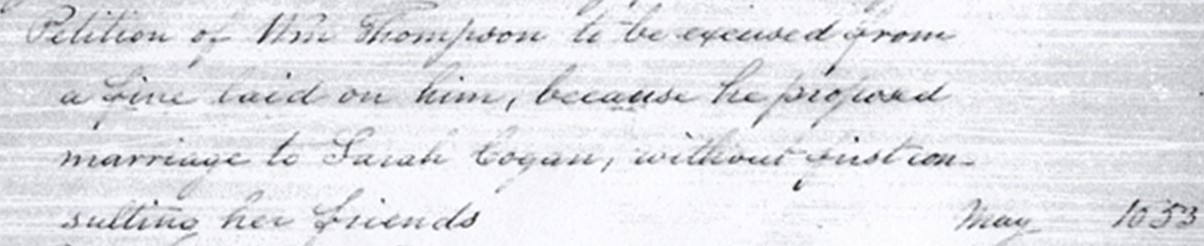
Detail from Volume 9, Massachusetts Archives Collection, photo by the author
     At some point in May of 1653, the following testimony was given:  "Petition of William Thompson to be excused from a fine laid on him, because he proposed marriage to Sarah Cogan, without first consulting her friends."
     Time didn't allow me to pursue the ultimate fate of William's pursuit of Sarah.  Was this a standard approach taken, when protocol was ignored?  Was she embarrassed or offended by his attentions?  Or did they experience a life together?  No matter the cause or the outcome, I had no problem picturing her "friends," the early-day Puritan busy-bodies, whispering behind their hands to each other.  After long days of labor in a harsh environment, followed by long hours spent at religious services, the couple's drama was perhaps a bright spot.  
     When we engage in modern-day gossip, we certainly aren't doing anything new.


Wednesday, September 30, 2015

But Wait - There's More! Selah Graves


     As ancestral sleuths, we are often told that it's a good idea to maintain a genealogical research plan, and keep track of negative findings as well as positive results.  But, just as often, my mind doesn't work like that.  Part of the fun for me, is to trip over a random genealogical discovery.  I have the kindness of others to thank for much of this; people have taken pains to transcribe, and make available online, obscure records that would otherwise be forgotten.
     Take this example:  I don't even remember how it popped into my head to search for my ancestor, Selah Graves, who died in Pike, Wyoming County, New York.  I put together his name in quotation marks, along with another descriptor, perhaps "Pike," and performed a Google search.  Low and behold, one of the results led me to another part of Selah's life that I had known nothing about:  his affiliation with the Masons.
     In 1828, Selah is described as the Master of the Morning Star Lodge, #295 in Pike, Wyoming County, New York.  In this capacity, his name appears on a letter to the state governing board of the Masons, describing the plight of his local lodge.  They had gone from 50 members to 15, "willing to stand the shock against Masonry."  They had used all their funds to build a hall, two of their wealthy members had died, and they were $80 in debt.  They asked if they could forgo paying dues at that time.  Failure to be granted this request would probably result in the Lodge's "Stopping Work."  The letter also records the name L. Couch, secretary.


     From a Wikipedia entry comes the following:  "William Morgan (1774–1826?) was a resident of Batavia, New York, whose disappearance and presumed murder in 1826 ignited a powerful movement against the Freemasons, a fraternal society that had become influential in the United States. After Morgan announced his intention to publish a book exposing Freemasonry's secrets, he was arrested on trumped-up charges. He disappeared soon after, and is believed to have been kidnapped and killed by some Masons.
The allegations surrounding Morgan's disappearance and presumed death sparked a public outcry and inspired Thurlow Weed and others to harness the discontent by founding the new Anti-Masonic Party in opposition to President Andrew Jackson's Democrats.  It ran a presidential candidate in 1832 but was nearly defunct by 1835."
     And so, not only have I gained another piece of evidence that helps me build a picture of my ancestor in particular, but I've also learned something about how he fit into the history of the time, and how he was impacted by a larger story.
     My thanks to Gary L. Heinmiller, who compiled various records of local Masonic Lodges in upstate New York.  The file can be accessed here:  http://www.omdhs.syracusemasons.com/sites/default/files/history/Craft%20Masonry%20in%20Livingston%20County.pdf
     

Monday, August 31, 2015

Lambert Eckerson home, Fawn River, St. Joseph County, MI


"Residence of L. Eckerson - Fawn River -Mich."
Original photo in possession of the author


     My great-grandfather, John Levi Eckerson, spent many years working his way from Michigan to Washington state, but there are few details of how or why he made the journey.  In 1880, he is found described on the census as "boring wells," and living as a boarder.  This was in Belvidere, Thayer County, Nebraska.  This may not have been a random decision, because his great-uncle, Willard W. Morgan, had also moved there in 1871.  In 1889, John L. Eckerson can next be found in the territorial census for Washington, living in Thurston County, single and working as a carpenter.  An 1891 newspaper notice states that his leg was broken while loading heavy timber onto railroad cars in Centralia, Lewis County.  He had evidently moved across the country living a rough and tumble existence.
     At the ripe age of 44, John L. Eckerson married 20-year-old Estella Channell in Lewis County, Washington.  A newspaper account of the event states that she was "quite a catch."  Perhaps they didn't quite understand her attraction to him, either!
     There is evidence that most of John Eckerson's siblings eventually moved west as well:  his older sister, Helen Butz, and his brothers Frank and Ernest are all found in Washington and Oregon.
     When I began my journey in genealogy, I asked my grandfather, John and Stella's only child, Harold Eckerson, where his father had come from.  The answer was always the same, "Hell's Half Acre!"  This was his way of saying he had no clue.  But if he'd bothered to look at the evidence, the answer might have been different.
     One of the items that somehow found its way west, was this photograph of the home in Fawn River, St. Joseph County, Michigan, where John L. Eckerson had grown up.  His parents were Lambert and Harriet Graves Eckerson, who had come to Michigan from Western New York.  Thankfully, the photograph is clearly identified as being the residence of L. Eckerson.
     There is a teenager standing in the center of the picture.  Is this John, on the cusp of his westward adventures?


Friday, July 31, 2015

No German? No problem! Lurena Largent

     The value of newspapers in our ancestral research can't be stressed often enough.  For those of us whose forebears didn't have the courtesy to leave a large paper trail in court documents, their occasional appearance in the local paper is spotted with excitement.  At last, another crumb to follow!
     But newspapers weren't published for the benefit of someone in the future studying their ancestry.  They were mostly printed on cheap materials meant to be thrown away.  Where they survive, the runs of available copies probably aren't complete.  Currently, online access represents only a portion of what might be locked away in distant vaults.  Where an "index" of sorts is available, it probably relies upon OCR (optical character recognition) technology, which produces either false positives, or misses entries entirely.  Blurred, water-stained pages with antique font are not technology-friendly.
     As is the case when using any sort of record, the biggest obstacles might be those we place in our own way.  Take, as an example, this entry pertaining to my ongoing research into the Largent family, of West Virginia, Kentucky, Ohio, and Indiana.
     A search on a newspaper portal for the name "Largent" generally returns a daunting number of hits.  That's because the word "largest" routinely shows up as a false positive.  One has to be prepared to wade through a lot of those, in hopes of finding one where the surname actually appears.  Which is what happened when I spotted "Lurena Largent" in the list of results.  The surrounding language not only was the usual garbled attempt produced by OCR, it wasn't even English, but what I recognized as German.  Here is the actual digitized document:

Indiana Tribüne, Volume 9, Number 203, 13 April 1886


     This image is courtesy of the Hoosier State Chronicles, part of the Indiana State Library.  It currently displays over 362,000 pages of Indiana newspapers.  Note that the title of the paper, the Indiana Tribüne, features an umlaut, a mark placed over a vowel in German and Hungarian.  This labor newspaper was published in Indianapolis for 53 years, claiming in 1898 to have the largest circulation of the German-language daily papers in Indiana.  It ceased publication in 1918, amid strong anti-German sentiment throughout the country during WWI.
     Closer examination shows that Lurena's name appears among those "heirathen," which means to marry or wed.  The names above are "Geburten" or births.  Using other sources, I have established that Lurena Largent is a distant cousin of mine with several removes.  Nothing in her ancestry suggests a connection to the German language.  What little I know of her husband, William W. Hutchins, doesn't either.  I believe these events were routinely copied out of local civil registers for publication.  The inclusion of Michael O'Donnell in the births would seem to confirm that.
     So, what if I'd gone about this search in a different way?  What if I'd looked at a list of available newspapers and said, "Oh, I won't bother with that one, it's in German, and she wouldn't be there."  What if this is the only place she's named?  This is one of those couples whose paper trail is meager. 
     The most frightening question I came away with?  What have I missed along the way?


Wednesday, June 24, 2015

My (Almost) Brush With Fame: Rose A. Simpson Riney

     
Rose A. Simpson Riney, photo courtesy Lillie Riney, findagrave.com
     Raking the leaves of the family tree sometimes turns up information that has us excited for at least a moment.  Is it possible we share the ancestry of a famous and well-regarded figure from history?  Or, perhaps we share a talent or characteristic of a more well-known distant cousin?  Sometimes, we get dazzled by the possibilities, and abandon sound research practices, in order to chase "our" star relative.   Luckily, I had studied my ancestry long enough, to know that when I read my distant grandmother's obituary, the last paragraph was based on wishful thinking, not fact.
     Rose (Rosa) A. Simpson was born in Kentucky in 1810, and lived well into the 20th century, her death occurring in December of 1908 in Lewis County, Missouri.  On her 19th birthday, in 1830, she married Richard Riney in Sangamon County, Illinois.  They eventually settled in Missouri, and were instrumental in the founding of the Shrine of St. Patrick in Lewis County, Missouri.  More information at:  St. Patrick Shrine .
     The last paragraph of her obituary would create excitement, to those not familiar with her story.  After all, Boones in Kentucky must all be related, right?  Well, no.


Obituary  published  22 December 1908 in The Quincy (Illinois) Daily Herald

     Besides the vast amount of available, verifiable information about Rosa's family, a quick look into Daniel Boone's own history reveals problems with the newspaper story.  His birth actually occurred in Berks County, Pennsylvania, in 1734.  His father, Squire Boone, had emigrated as a teenager to Pennsylvania from England.  Around 1750, the family moved to the Yadkin River valley of North Carolina.  Daniel Boone's earliest trip to Kentucky took place when he was in his mid 30s.  This family had followed the Quaker faith in both England and America.
     Rose A. Simpson did indeed have a Boone surname in her heritage.  Her mother, Mary Alice Boone, was the daughter of John Boone, whose will was written in Washington County, Kentucky, in 1809.  This family had long been connected to the Catholic Church.  An earlier John Boone had donated land on which a Catholic Chapel was erected around 1710 in St. George's County, Maryland.    This family was part of what legend calls "The Maryland League," groups of Catholic families who, beginning in the 1780s, banded together to emigrate from Maryland to Kentucky.  Rose's grandfather, John Boone, was part of the Hardin's Creek settlement, which was later known as Saint Charles, Saint Mary's, and finally, St. Mary.  This part of Washington County was divided off into Mercer County in 1834.
     Interestingly, the newspaper obituary for Rose Simpson Riney published closer to her residence in Missouri, doesn't make mention of a connection to Daniel Boone.  Perhaps, as often happens, a descendant in Quincy really wanted for the story to be true.
     While the Maryland Boones may owe thanks to Daniel Boone for making it possible to settle later in Kentucky, they otherwise may have only shared a connection in the distant past.  They certainly couldn't claim him as their "Uncle Dan."

Note, the excellent online newspaper records of the Quincy, Illinois Public Library have been an invaluable source in my research.  They are available here:  Quincy, Illinois newspaper research .


Saturday, May 23, 2015

Heritage Roses: Myers-Burgard property, Centralia, WA


Photos of the "mystery roses" by the author
     I have written before, about having visited the site where the home of Isaac L. and Esther Burgard Myers was located.  It stood at the southeast corner of Gold and Locust Streets in Centralia, Lewis County, Washington.
     When I first began going to view the property, the house they had built around the turn of the 20th century was still standing, although in very bad shape.  On later visits, the house had finally been pulled down, the site cleared and put up for sale.
     Along the rear of the property was a fence, where a wild tangle of various plants grew unchecked.  Since I always visited in the summer, I was able to see that some of them were a few different varieties of roses in bloom.  Although I'm no rose expert, a couple of these seemed to have characteristics of roses first introduced many, many decades ago.  There was also a grape vine of some type, probably that of a table grape.


    Eventually, my husband and I managed to successfully take some cuttings off the various roses, and propagate them two states away at our home in California.  One is a very pale pink, with fragile blooms of the "old-fashioned" variety.  It blooms briefly in late spring.  The other is a vigorous plant that grows like a weed, wherever it puts down roots.  It's a very strong pink color, and has a long blooming season.  Sadly, the attempt to successfully grow a cutting from the grape vine was a failure, despite several tries.


     There is no way of knowing whether these plants were those known to, or planted by, Isaac and Esther Burgard Myers.  But, in my mind, I'd like to believe that perhaps, as they lived out their golden years at this location, they also enjoyed a chance to "stop and smell the roses."

Thursday, April 30, 2015

He's Just Not That Into You: James Willison & Violet Blackmore


     The approach taken by the individual responsible for putting final court records down on paper can make a huge difference in what can be learned about our ancestors.  In Hamilton County, Indiana, during the 1820s, that person apparently had an endless supply of ink and paper, an abundance of energy, and the personality of a born gossip.
     Take, for example, the petition for divorce filed by James Willison against Violet Willison on 18 July 1827.  It states that the two were married in 1823, and that she was the former Violet Blackmore.  His statement has some dramatic quotes, such as, “with whom he lived demeaning himself toward her in all respect faithfully and affectionately” until about 1 May 1825 “she abandoned him.”  On Violet’s side, she said, “He would divide his pork and dodger* with her, but that he would not sleep with her.”  Violet went to live with her parents, stating that “she would live with him if he slept with her.”
     Ultimately, the court found insufficient evidence for divorce.  She should recover her costs from him.
     Of great interest is the fact that the court session was held at the house of Joseph Willison, and that an associate judge in attendance was William C. Blackmore.  Perhaps neither of them could be considered disinterested parties.
     Intrigued, I did a quick look on Ancestry.com, FamilySearch.org, and the Indiana State Library website.  No evidence is easily found, that a relationship between these two parties ever existed, not in indexed marriage records, and certainly not in unsourced pedigree charts.  There are indeed a couple of men of that name, who lived in Indiana around the right time frame.  Anyone researching a James Willison may want to consider the possibility that another chapter needs to be added to his story.  As for Violet Blackmore Willison, this may be one of the only indications that this woman ever existed.     
     I salute these frontier gossips, who took such time bringing their neighbors to life.

Source:  FHC#2412383 Hamilton Co., IN circuit court final record 1824-1842

*dodger:  a small, hard fried or baked cornmeal cake, a boiled cornmeal dumpling.

Photo courtesy www.flickr.com/photos/lwr/2876984696/

Tuesday, March 31, 2015

James Suit: Friend AND Foe

    
     Elizabeth Shown Mills, and other respected genealogists, have long emphasized the importance of studying our ancestor’s FAN club:  friends, associates, and neighbors.  While it’s taken me awhile to expand my tunnel vision, and to accept that my research needs to include a larger pool of subjects, I’m beginning to reap the benefits.
     My ancestor, Asa Oren Ives, will never be an easy subject to study.  Although there are strong clues which suggest his origins are in Vermont, I’m focusing now on digging as deeply as I can in Indiana, where known events of his life took place.  Since his paper trail is pretty meager, I've turned my attention to his associates, hoping to create a picture of his life through their experiences.
     At the time of Asa’s 1827 marriage to Mary “Polly” Largent in Lafayette, Tippecanoe County, the bondsman was James Suit.  I wondered what the connection was between this couple and their bondsman, so I began to collect information that might answer the question. 
     The following sketch appears in an historic county history, which has been digitized at http://www.ingenweb.org/intippecanoe/twp.html:  "The first white man to come to Wabash Township was probably James Suit, a trapper, who came in 1822. He employed a number of men to assist him in trapping beaver and collecting wild honey from the forests of Tippecanoe County. He would take these items down the river by flatboat to Vincennes where he would trade for salt, Mackinaw blankets, dry goods, whiskey and general merchandise."    This may conjure up the image of a loner on the move, with no fixed address.  My research proves otherwise.  While James Suit’s occupations required time away from home, he maintained strong personal ties to Lafayette.


  Examination of land records in Tippecanoe County reveals that James Suit and his wife were involved in a number of transactions, which name many other parties.  The name of James’ wife is variously listed as Amy, Bethama, and Bethamy.  In 1828, a marriage for Sarah Suit is recorded, with James Suit named as her father.  James Suit is also shown on a list of potential grand jurors in 1827.  In strong contrast, he was fined twice for assault and battery upon the body of:  Asa Oren Ives!  The two assaults bookended the wedding:  one taking place before, and one after.  They evidently endured a rather tempestuous relationship, to say the least.  They were hardly alone:  the court records are filled with accounts of neighbors settling their differences by less than peaceful means!
     Reaching back earlier in time, James Suit spent a short period as a sergeant in (Christopher) Wood’s 1st Ohio Company of Spies during the War of 1812.  A John Suit served as a private in the same unit.  This company was formed in Champaign County, Ohio, where James Suit voted in an early Sheriff’s election.  It was also here that he married Amy Davis in 1806.
     The location of Champaign County, Ohio, makes me believe that the basis for James Suit serving as a bondsman, was due to a connection to Mary “Polly” Largent.  Her father and other relatives lived in the same township as James Suit, during the time they were all in Ohio.  Perhaps James Suit took a dim view of Asa Oren Ives as husband material?
     
Wabash River, Lafayette, Indiana.  Taken by the author.
     As 
I've discovered, when information about our own ancestors is lacking, including the FAN club in our research can be enlightening, fascinating, and highly entertaining!